



Industry Overview & Market Context
Modern display infrastructure relies heavily on compact conversion hardware to bridge divergent physical interfaces and signal protocols across consumer electronics, corporate workstations, and industrial AV networks. As source devices increasingly adopt multi-function USB Type-C and DisplayPort interfaces while display terminals retain HDMI 2.0 and HDMI 2.1 inputs, high-performance HDMI adapters have evolved from simple passive pass-through dongles into active, high-bandwidth signal translation units. Commercial deployments require these devices to handle uncompressed video matrices up to 48 Gbps, pass multi-channel digital audio, enforce HDCP encryption key exchanges, and manage high-wattage USB Power Delivery (PD) simultaneously without introducing system latency or thermal degradation.
For system integrators, hardware brands, and enterprise procurement leads, selecting and manufacturing reliable HDMI adapters demands a thorough understanding of signal integrity engineering, active chipset topologies, and strict thermal dissipation boundaries. At szaost.com, our engineering and manufacturing teams leverage specialized SMT lines, automated physical testing, and high-precision PCB layouts to deliver scalable OEM/ODM adapter solutions designed for demanding global deployment environments.
HDMI Adapters Classification & Core Application Scenarios
USB-C to HDMI Adapters for Next-Gen Laptops and Smart Devices
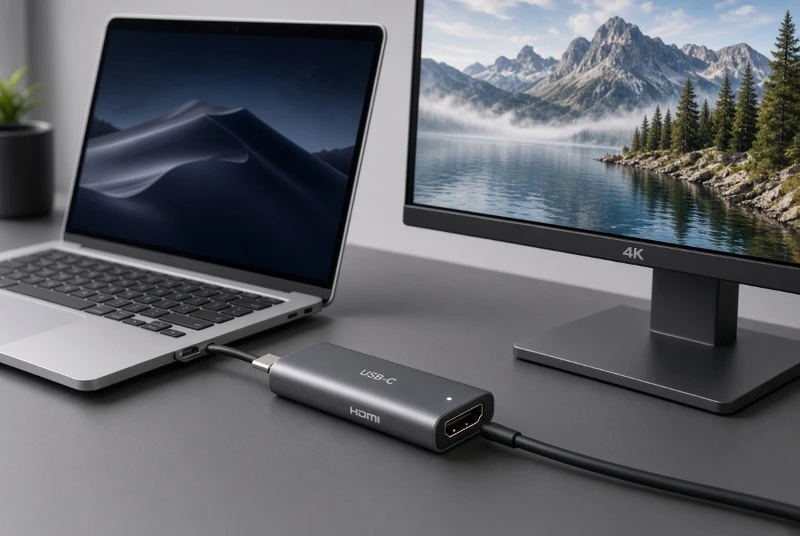
USB-C to HDMI adapters utilize DisplayPort Alternate Mode (DP Alt Mode) protocol conversion via active bridge ICs to output native HDMI video and audio signals from modern Type-C interfaces. Because an HDMI monitor cannot directly process raw DisplayPort signals from a Type-C connector's high-speed differential lanes, an active protocol conversion IC (such as the Parade PS186 or Realtek RTD2172) is required inside the adapter. This IC deserializes incoming DP Alt Mode streams, maps hardware protocols, and re-encodes signals into TMDS or FRL standards for HDMI receivers.
Engineering commercial USB-C to HDMI adapters involves two major technical configurations:
Four-Lane DP 1.4 HBR3 Links: Provides up to 25.92 Gbps of raw video bandwidth, supporting uncompressed 4K output at 60Hz or up to 120Hz with Display Stream Compression (DSC).
Integrated Power Delivery (PD 3.0/3.1): Incorporates dedicated PD controller ICs to route up to 100W–140W pass-through charging back to the host laptop without interrupting the high-bandwidth video stream.
Multi-Protocol Video Adapters (DP, DVI, VGA to HDMI)
Cross-protocol HDMI adapters translate distinct electrical signaling standards-from legacy analog RGB in VGA to digital dual-mode DP++-into standard HDMI digital packets. Managing cross-generational video systems across enterprise or medical facilities relies on specific hardware conversion techniques:
DisplayPort to HDMI Conversion: Leverages DP++ (Dual-Mode DisplayPort) source signals for passive pass-through, or uses active conversion chipsets when DP++ is unavailable or when driven by Multi-Stream Transport (MST) hubs.
VGA Analog to Digital Conversion: Passes analog RGB and H/V-Sync signals through a high-frequency Analog-to-Digital Converter (ADC) operating above 165 MHz. Simultaneously, audio ADCs digitize 3.5mm analog audio into I2S streams, multiplexing them directly into HDMI auxiliary data blocks alongside EDID handshake parameters.
Compact Dongles vs. Multi-Functional Display Hubs
Compact single-port dongles prioritize minimal physical footprints and direct signal paths, whereas multi-functional hubs employ complex multi-layer PCBs with onboard controller ICs to multiplex video, Ethernet, and high-speed data.
When choosing an optimal form factor for custom production, engineers evaluate the structural differences:
Single-Port Dongles: Built on 2-layer or 4-layer PCBs with a single active bridge IC and ESD protection arrays. Operating under 0.5W power draw, they dissipate heat naturally through small aluminum or molded housing.
Multi-Port Display Hubs: Require 6-layer to 8-layer High-Density Interconnect (HDI) PCBs to eliminate crosstalk between video pairs, USB 10Gbps traces, and Gigabit Ethernet controllers. Generating 2W to 5W of heat under full PD charging load, these hubs require internal silicone thermal pads and conductive aluminum housings to keep operating temperatures below 45°C.
Technical Specifications & Performance Benchmarks
HDMI 1.4, 2.0, and 2.1 Bandwidth Requirements (4K/8K Standards)
Physical layer bandwidth limits set rigid boundaries for active bridge chips and internal PCB trace layouts across successive HDMI standard releases. HDMI 1.4 uses 3-lane TMDS encoding up to 340 MHz, capping aggregate bandwidth at 10.2 Gbps (8.16 Gbps payload) and limiting output to 4K 30Hz. HDMI 2.0 pushes TMDS clocks to 600 MHz per channel, expanding bandwidth to 18.0 Gbps (14.4 Gbps payload) to support uncompressed 4K 60Hz at 4:4:4 chroma.
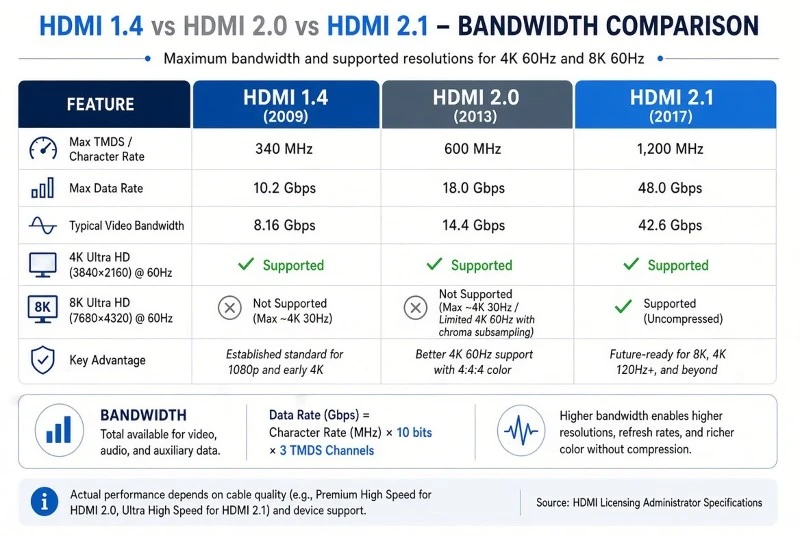
HDMI 2.1 replaces TMDS with Fixed Rate Link (FRL) architecture across 4 data lanes operating up to 12 Gbps per lane, reaching 48 Gbps aggregate bandwidth (42.66 Gbps effective payload). This jump enables uncompressed 8K 60Hz and 4K 120Hz throughput.
Table 1: Technical Comparative Matrix of HDMI Version Specifications
|
HDMI Standard |
Max Aggregate Bandwidth |
Max Payload Data Rate |
Signaling Mechanism |
Max Supported Resolution & Refresh Rate |
Color Chroma Subsampling |
|
HDMI 1.4 |
10.2 Gbps |
8.16 Gbps |
3-Lane TMDS (340 MHz) |
4K (3840x2160) @ 30Hz / 1080p @ 120Hz |
8-bit RGB / 4:4:4 |
|
HDMI 2.0b |
18.0 Gbps |
14.40 Gbps |
3-Lane TMDS (600 MHz) |
4K (3840x2160) @ 60Hz / 1440p @ 144Hz |
8-bit 4:4:4 / 10-bit HDR 4:2:0 |
|
HDMI 2.1a |
48.0 Gbps |
42.66 Gbps |
4-Lane FRL (12 Gbps/lane) |
8K (7680x4320) @ 60Hz / 4K @ 120Hz |
10-bit/12-bit 4:4:4 (or DSC 1.2a) |
IC Chipset Selection and Signal Conversion Efficiency
Active IC silicon selection determines signal conversion integrity, HDCP encryption stability, and EDID negotiation speed in active HDMI adapters. Cheap, non-branded bridge ICs frequently yield high bit error rates (BER), prolonged HDCP handshake delays, and EDID table parsing failures.
High-tier active ICs from established suppliers (such as Realtek, Parade, and Synaptics) prevent signal degradation through integrated hardware modules:
Adaptive Equalizers: Dynamically compensate for high-frequency signal attenuation caused by long PCB traces or cable assemblies.
Clock-Data Recovery (CDR) & Low-Jitter PLLs: Clean up signal phase noise, keeping the differential signal eye diagram wide open and maintaining bit error rates below BER < 10-12.
Structural Hardware Standards: EMI Shielding, Heat Dissipation & Durability
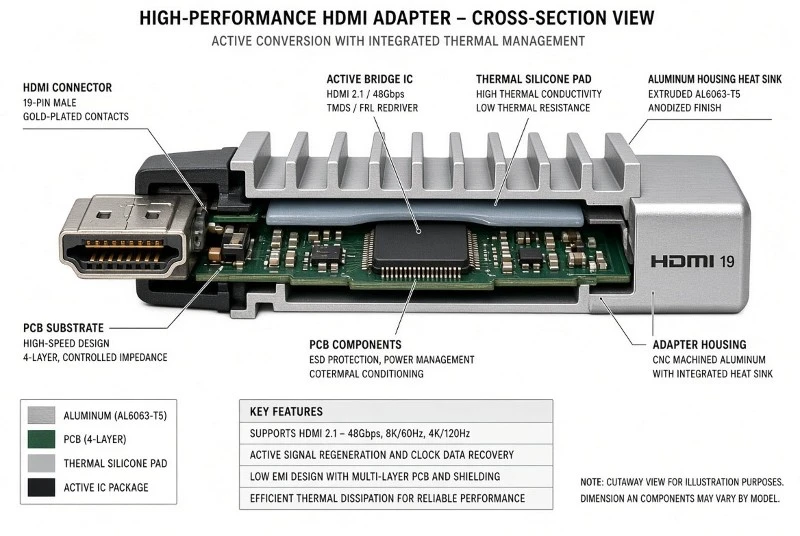
Multi-stage electromagnetic interference (EMI) shielding and integrated thermal conductive pathways protect high-speed video signals while preventing physical component degradation. Multi-gigahertz differential signals radiate interference that can compromise nearby 2.4 GHz Wi-Fi and Bluetooth performance. Industrial-grade adapters resolve this by soldering a stamped tin-plate metal box over the PCB assembly prior to housing assembly.
Thermal engineering follows strict conductive principles:
Heat Transfer: High-thermal-conductivity silicone pads (K>3.0 W/m·K) bridge the active bridge IC die directly to an anodized aluminum casing.
Radiative Cooling: The aluminum housing acts as an external heat sink, preventing IC thermal throttling and preserving frame stability during continuous operation.
Identifying Quality Risks in Mass-Produced HDMI Adapters
Thermal Throttling and Signal Interruption
Thermal throttling occurs when accumulated conversion heat elevates silicon junction temperatures beyond operating limits, causing display blackouts, audio drops, or sync failure. Processing uncompressed 4K 60Hz video streams generates steady thermal energy that can drive internal IC junction temperatures past 85°C in unoptimized plastic enclosures. Without effective thermal relief, onboard Phase-Locked Loops (PLLs) lose phase lock, causing screen flickering and complete display drops.
At szaost.com, our engineers mitigate thermal degradation by conducting thermal camera mapping during prototype development, validating stable heat dissipation across 72-hour continuous burn-in stress tests.
Cross-OS Firmware Incompatibility Issues
Firmware microcode errors during EDID and HDCP handshakes cause display setup failures across different host operating systems like macOS, Windows, and ChromeOS. Operating systems interpret display timing data differently; for example, macOS relies on specific DisplayID timing structures that differ from VESA standards used by Windows. If adapter microcode fails to process these tables accurately, host systems may default to incorrect aspect ratios or fall back to 1080p 30Hz.
HDCP content protection presents additional handshake failure risks:
Key Renegotiation Dropouts: Streaming HDCP 2.2/2.3 encrypted media (e.g., Netflix, 4K Blu-ray) requires continuous key validation between source, adapter, and display.
Fallback Latency: Flawed firmware microcode causes key exchange timeouts, forcing systems to drop video resolution down to 480p or blank the screen entirely.
Physical Wear and High Defect Rates in Low-End Components
Mechanical stress on connector solder joints and corrosion on contact plating account for the vast majority of field returns and reduced product lifespans in cheap adapters. Repeated insertion, extraction, and cable bending exert shear forces directly on surface-mounted PCB pads. SMT joints without mechanical retention posts crack easily under repeated physical strain.
Furthermore, flash-gold or nickel connectors oxidize over time when exposed to humidity, increasing electrical contact resistance. Industrial manufacturing uses two specific countermeasures:
High-Cycle Gold Plating: Applying 3u" to 15u" gold plating on connector pins to maintain low contact resistance.
TPE Strain Reliefs: Molded Thermoplastic Elastomer boots distribute bending forces, preventing wire fatigue at the connector junction.
Custom HDMI Adapter Manufacturing Excellence at szaost.com
End-to-End OEM/ODM Customization Services
szaost.com offers complete OEM/ODM manufacturing solutions-covering PCB schematic design, housing tooling, custom firmware flashing, and branded retail packaging. We partner with global brand owners and IT distributors to transform performance specifications into market-ready products.
Our customization engineering capabilities include:
PCB Layout & Schematic Capture: Multi-layer HDI board design with precise $100\Omega \pm 10\%$ differential impedance control.
Housing & Structural Tooling: CNC-machined aluminum enclosures, ABS plastic housings, and custom PANTONE color matching.
Tailored Firmware Flashing: Custom EDID injection, fixed resolution locking for commercial displays, and modified USB PD power profiles.
Branding & Packaging: Precision laser-etched logos, custom silk-screening, and retail-ready packaging.
Industrial-Grade Testing Protocols & Global Certifications
Automated signal integrity verification, physical durability testing, and international compliance certifications are integrated directly into szaost.com's manufacturing workflow. Before production sign-off, high-bandwidth oscilloscopes and Time-Domain Reflectometers (TDR) evaluate high-speed differential pairs to verify eye-diagram height, width, and jitter margins.
100% of mass-produced units pass automated functional test stations to confirm 4K/8K video transmission, HDCP key exchanges, and multi-platform compatibility.
Table 2: Quality Assurance Testing Protocols at szaost.com
|
Testing Category |
Equipment & Method |
Standard & Target Threshold |
|
Signal Integrity Test |
Keysight High-Performance Oscilloscope & TDR |
Differential Impedance $100\Omega \pm 10\%$; Eye Diagram Mask Compliance |
|
Mechanical Durability |
Automated Plug/Unplug Tester & 180° Cable Flexing Machine |
>10,000 Connector Insertions; >5,000 Flex Cycles under 200g load |
|
Thermal Stress Test |
Environmental Thermal Chamber & FLIR Infrared Imaging |
72 Hours continuous burn-in at 45°C ambient; Die Temp <75°C |
|
OS & HDCP Compatibility |
Multi-Platform OS Test Rig (macOS, Win 11, ChromeOS) |
100% HDCP 2.2/2.3 handshake pass rate; Zero EDID parse dropouts |
Advanced SMT Infrastructure and High-Capacity Production
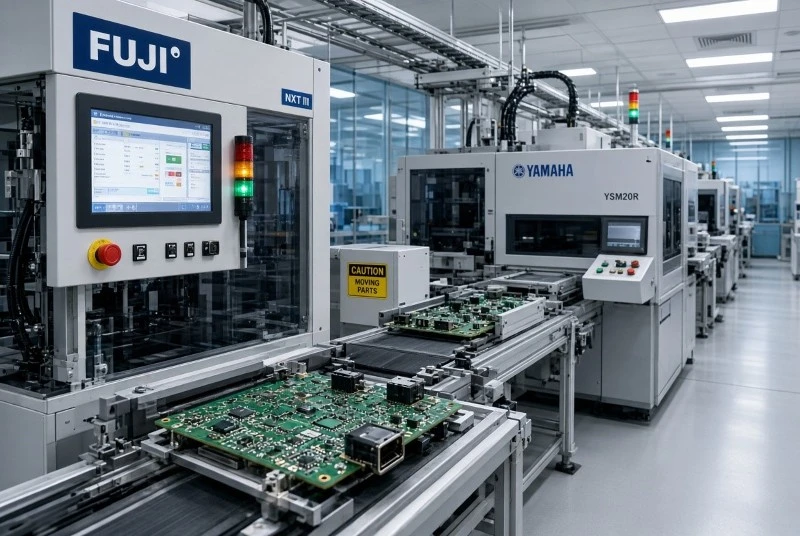
Automated Surface Mount Technology (SMT) lines combined with 3D optical inspection allow szaost.com to maintain high-volume output, tight quality tolerances, and short production lead times. Our facility operates high-speed Fuji and Yamaha chip placement machines capable of mounting fine-pitch micro-BGA chips and 0201 passive components with high precision.
Quality control across our SMT assembly line includes:
Solder Paste Inspection (SPI): Measures solder paste volume and placement accuracy prior to component mounting.
3D Automated Optical Inspection (AOI): Scans 100% of soldered assemblies post-reflow to detect bridging, component misalignment, or cold solder joints.
This production capacity supports low-volume trial runs for new product launches as well as large monthly shipments for global distributors
.
Partner with szaost.com for Reliable Display Adapter Solutions
Selecting high-performance HDMI adapters requires balancing strict signal specifications, reliable chipset architecture, effective thermal design, and robust manufacturing standards. As display technologies advance toward higher resolutions, elevated refresh rates, and multi-protocol integration, partnering with an experienced manufacturing specialist is key to delivering dependable connectivity products.
At szaost.com, we combine deep hardware engineering expertise, rigorous quality control, and comprehensive OEM/ODM customization services to produce market-leading adapter solutions. Whether you are expanding your retail hardware line, developing specialized AV integration equipment, or seeking a reliable contract manufacturing partner, our team is equipped to support your goals.
FAQ about HDMI Adapters
Q1: What is the difference between active and passive HDMI adapters?
Passive adapters rely on the host device's native ability to output HDMI-compatible signals (such as DP++), merely changing the physical pin configuration. Active adapters contain dedicated protocol bridge ICs (like Realtek or Parade chips) that actively deserialize, re-encode, and equalize signals, making them necessary for USB-C DP Alt Mode, Multi-Stream Transport (MST) hubs, or conversions like VGA/DVI to HDMI.
Q2: Why do cheap HDMI adapters suffer from screen flickering or display blackouts?
Display drops and flickering typically stem from two factors: thermal throttling and poor signal integrity. Low-cost adapters lack adequate heat dissipation, causing the IC junction temperature to exceed limits and drop signal synchronization. Additionally, subpar IC chipsets with high bit error rates ($\text{BER}$) and unshielded designs cause HDCP handshake timeouts and EMI signal interference.
Q3: Can a USB-C to HDMI adapter support both 4K 120Hz/8K video output and laptop charging simultaneously?
Yes, provided the adapter uses high-bandwidth DisplayPort 1.4/2.1 Alternate Mode with DSC support alongside an integrated USB Power Delivery (PD 3.0/3.1) controller IC. This architecture allows up to 48 Gbps aggregate video throughput while passing up to 100W–140W of charging power back to the host device.
Q4: How does szaost.com address cross-OS compatibility issues with macOS, Windows, and ChromeOS?
We flash custom, optimized microcode firmware that accurately parses different OS-specific display profiles-such as macOS DisplayID structures vs. VESA timing standards used in Windows. Our automated testing rigs run 100% functional checks across multiple operating systems to ensure seamless EDID negotiation and stable HDCP 2.2/2.3 key exchanges.
Q5: What OEM/ODM customization options are available for bulk manufacturing?
szaost.com offers complete end-to-end customization, including PCB layout design (100Ω ±10% differential impedance control), custom CNC/molded housings (aluminum/ABS), tailored firmware flashing (fixed EDID locking or modified PD profiles), laser-etched branding, and retail packaging. All mass production undergoes rigorous 3D AOI inspection, thermal stress testing, and mechanical flex validation.


