



HDMI extender to RJ45 solutions have become essential for reliable long-distance AV transmission in both residential and commercial environments. By converting HDMI signals for transmission over standard Cat5e or Cat6 Ethernet cables, these extenders overcome the severe length limitations of traditional HDMI cables while maintaining high-quality video and audio performance.
This comprehensive guide examines the technology behind HDMI extender RJ45 systems, their practical benefits, real-world applications, and critical selection criteria. Whether you are a system integrator, AV professional, or end user planning a complex installation, understanding these tools ensures optimal signal integrity and cost efficiency.
What Is an HDMI Extender RJ45 and How Does It Work?
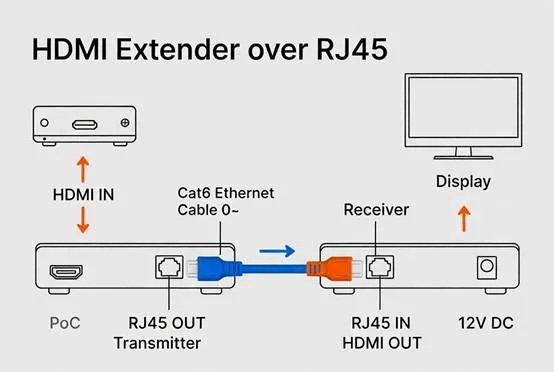
An HDMI extender to RJ45 (also known as HDMI over Cat6 or HDMI balun extender) consists of a transmitter unit and a receiver unit connected by a single Ethernet cable. The transmitter converts the digital HDMI signal into a balanced differential signal suitable for twisted-pair transmission, while the receiver reconverts it back to standard HDMI format at the display end.
Core Components: Transmitter, Receiver, and RJ45 Interface
The transmitter features an HDMI input, RJ45 output, and often local loop-through HDMI output for monitoring. The receiver includes an RJ45 input and HDMI output. Most modern units support Power over Cable (PoC), allowing the receiver to draw power from the transmitter via the Cat6 cable, simplifying installation by eliminating extra power adapters at the remote end.
High-quality units incorporate robust shielding, surge protection, and EDID management to ensure compatibility across different source and display combinations.
Signal Conversion Technology – From HDMI to Balanced Twisted Pair
The conversion process uses TMDS (Transition-Minimized Differential Signaling) encoding adapted for twisted-pair cabling. HDMI signals, which are highly susceptible to electromagnetic interference over long runs, are transformed into balanced signals that leverage the noise-rejecting properties of Cat6 twisted pairs. This enables stable transmission distances far beyond the 10-15 meters typical of passive HDMI cables.
Advanced models apply light compression or equalization techniques to maintain 4K resolution with HDR while staying within the bandwidth limits of Ethernet cabling.
Comparison with Traditional HDMI Cables and Wireless Solutions
Traditional HDMI cables suffer rapid signal degradation beyond 10-15 meters for 4K content due to attenuation and jitter. Wireless HDMI extenders introduce latency, potential interference, and compression artifacts, making them unsuitable for critical applications.
HDMI extender to RJ45 systems offer a wired, low-latency alternative that utilizes existing structured cabling infrastructure, delivering superior reliability and often lower total cost of ownership. Professional installers consistently report fewer dropouts and better long-term stability compared to wireless alternatives.
Key Benefits of Using HDMI Over Cat6 / RJ45 Extenders
HDMI extender RJ45 solutions address multiple pain points in AV distribution.
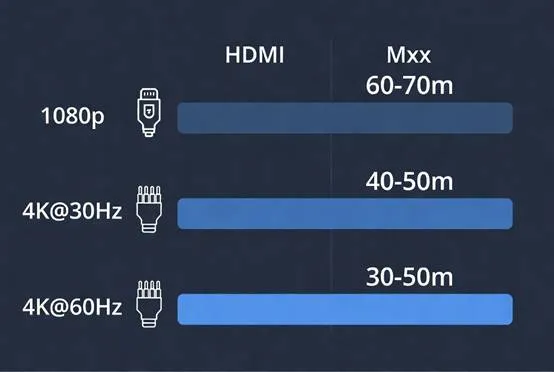
Extended Transmission Distance Up to 100m+ Without Signal Loss
Depending on resolution and cable quality, these extenders reliably achieve:
1080p: Up to 60-70 meters (200+ feet)
4K@30Hz: Up to 40-50 meters
4K@60Hz (with higher-end models): Up to 30-50 meters over Cat6/Cat6a
These distances make them ideal for large venues where running direct HDMI is impractical.
Cost-Effective Infrastructure Using Existing Ethernet Cabling
One of the strongest advantages is leveraging pre-installed Cat5e/Cat6 networks. This eliminates expensive custom HDMI cable pulls and conduit work, significantly reducing labor and material costs in retrofits and new builds.
Support for 4K@60Hz, HDR, and Multi-Channel Audio
Contemporary HDMI extender to RJ45 kits support HDMI 2.0/2.1 features including HDR10, Dolby Vision (on select models), up to 18Gbps bandwidth, and high-bitrate audio formats like Dolby Atmos. Chroma subsampling (4:4:4) is preserved in premium units for sharp text and graphics in commercial displays.
Enhanced Stability and Interference Resistance
Twisted-pair transmission provides excellent common-mode rejection, making these systems far more immune to EMI/RFI than long HDMI runs. Shielded Cat6 (STP) further improves performance in electrically noisy environments such as industrial facilities or near power lines.
|
Resolution |
Typical Max Distance (Cat6) |
Key Features Supported |
Recommended Cable |
|
1080p@60Hz |
60-70m |
3D, Multi-channel Audio |
Cat5e/Cat6 |
|
4K@30Hz |
40-50m |
HDR, HDCP 2.2 |
Cat6 |
|
4K@60Hz 4:4:4 |
30-50m |
HDR10, Dolby Vision (select) |
Cat6a/Cat7 |
|
1080p with IR/RS232 |
50-70m |
Bidirectional Control |
Cat6 |
Common Applications for HDMI Extender RJ45 Solutions

Home Theater and Multi-Room AV Distribution
Homeowners use HDMI extender RJ45 to send 4K signals from a central media rack to projectors or TVs in different rooms. This enables clean, hidden installations without visible cable runs.
Commercial Installations: Conference Rooms, Digital Signage, and CCTV
In corporate settings, these extenders connect presentation sources to large displays in boardrooms. Digital signage networks benefit from centralized content players feeding multiple remote screens. Security integrators frequently deploy HDMI to RJ45 for extending NVR outputs to monitoring stations over existing network infrastructure.
Education, Healthcare, and Large Venues
Lecture halls, classrooms, and training centers rely on these for reliable distribution from lecterns to projection systems. Hospitals use them for extending imaging sources to operating rooms or waiting areas while maintaining strict cable management standards. Stadiums and auditoriums leverage the technology for scoreboards and overflow displays.
KVM and Control Signal Extension
Many kits support bidirectional IR, RS232, or CEC control, allowing full KVM-like operation where users can control the source device from the remote display location.
How to Choose the Right HDMI Extender RJ45 for Your Needs
Selecting the optimal HDMI extender to RJ45 requires careful evaluation of technical requirements.
Resolution, Refresh Rate, and Bandwidth Considerations (1080p vs 4K)
For basic 1080p applications, entry-level units suffice. However, 4K@60Hz installations demand units rated for at least 18Gbps with proper HDCP 2.2/2.3 compliance. Always verify actual tested performance rather than theoretical maximums.
Cable Type and Length: Cat5e, Cat6, Cat6a Recommendations
Cat6 is the sweet spot for most installations, offering better crosstalk performance than Cat5e. For maximum distance and 4K60 reliability, Cat6a or Cat7 provides headroom. Solid-core cable performs better than stranded for permanent runs.
Additional Features: PoE, IR Control, RS232, EDID Management
Look for PoC (Power over Cable) to simplify deployment. Bidirectional IR and RS232 enable remote device control. Advanced EDID emulation prevents handshake issues between sources and displays.
Avoiding Common Pitfalls in Selection
Common mistakes include under-specifying bandwidth for future-proofing, ignoring cable quality, or choosing units without proper HDCP support. Always match the extender's capabilities to your highest required resolution and distance, with a safety margin.
Why Partner with a Professional HDMI Extender Manufacturer Like Aost
In a market flooded with options, partnering with an experienced manufacturer ensures consistent performance and long-term reliability. Aost (szaost.com) brings decades of specialized expertise in AV signal transmission products.
With in-house R&D teams, stringent quality control processes, and advanced testing laboratories, professional manufacturers develop solutions that meet or exceed industry standards for signal integrity and durability. They offer extensive customization options - from firmware adjustments and enclosure designs to full OEM/ODM services with private labeling for system integrators and distributors.
Their commitment to HDCP compliance, rigorous burn-in testing, and use of premium components results in products with lower failure rates and better real-world performance. Bulk buyers and project developers benefit from scalable production capacity, technical support, and tailored solutions that generic suppliers cannot match.
When evaluating manufacturers, prioritize those with proven track records in both residential and commercial AV projects, transparent specifications, and responsive engineering support.
FAQ about HDMI Extender to Rj45
Q1: What is the maximum transmission distance of HDMI Extender RJ45?
A1: Over Cat6 cable, typical distances are 60-70m for 1080p and 30-50m for 4K@60Hz, depending on model and cable quality.
Q2: Can HDMI Extender RJ45 support 4K HDR?
A2: Yes, most modern units fully support 4K@30Hz or 4K@60Hz with HDR10 and HDCP 2.2/2.3 compliance.
Q3: Do I need separate power adapters for both transmitter and receiver?
A3: Not necessarily. Most units feature PoC (Power over Cable), so only the transmitter needs power.
Q4: Is HDMI Extender RJ45 better than wireless HDMI extenders?
A4: Yes. It offers lower latency, higher stability, better image quality, and greater reliability, especially in commercial environments.
Conclusion
HDMI extender RJ45 technology, particularly HDMI over Cat6 solutions, provides one of the most practical, reliable, and cost-effective methods for long-distance high-definition AV transmission available today. By leveraging ubiquitous Ethernet infrastructure, these systems deliver exceptional performance where traditional cables fall short and wireless alternatives prove unreliable.
Whether implementing a home theater, corporate AV network, or large-scale digital signage deployment, choosing the right HDMI extender to RJ45 solution - backed by a professional manufacturer - ensures your installation performs flawlessly for years to come.
For tailored solutions, bulk OEM/ODM requirements, or expert technical consultation on your next project, visit szaost.com or contact the Aost engineering team directly. Their specialized manufacturing capabilities can help bring reliable, high-performance HDMI extension to your specific application.


